


Daily drawdown is the maximum amount a prop trader can lose in a single trading day before violating the firm’s rules. To avoid breaching it, traders need smaller position sizes, a personal loss limit below the firm’s threshold, and real-time visibility into open risk, not just closed.
The Blunt Truth About Prop Firm Failure
Imagine weeks of discipline evaporating in one chaotic afternoon. You’ve mastered your entries, but a single "revenge trade" or a sudden spike in volatility hits your daily limit. The dashboard turns red, the account is disabled, and your progress vanishes.
The blunt truth is that most prop firm failures don't happen because of a lack of edge. They happen because traders break a risk rule before their strategy has time to work.
Daily drawdown is the ultimate "account killer." It is the invisible ceiling that crashes down when survival is forgotten.
Why Daily Drawdown is the "Silent Killer"
For professional allocators, the daily loss limit is the ultimate test of psychological stability.
- The Math of Ruin: A 60%-win rate strategy can still hit a three-loss streak. If those happen in one session with aggressive sizing, you are out, even if the next trade was a winner.
- The Emotional Spiral: Approaching the limit creates physical pressure to "make it back." This is where most traders abandon their plan and trigger a breach.
We will dismantle the retail obsession with "being right" and replace it with a professional framework for protecting your buffer and using real-time analytics to ensure you never hit the "hard wall."
What daily drawdown means in a prop firm challenge
Daily drawdown, or the daily loss limit, is the maximum amount of capital your account can lose within a single 24-hour window. It acts as a hard stop designed to protect the firm from extreme volatility and to protect you from "tilt."
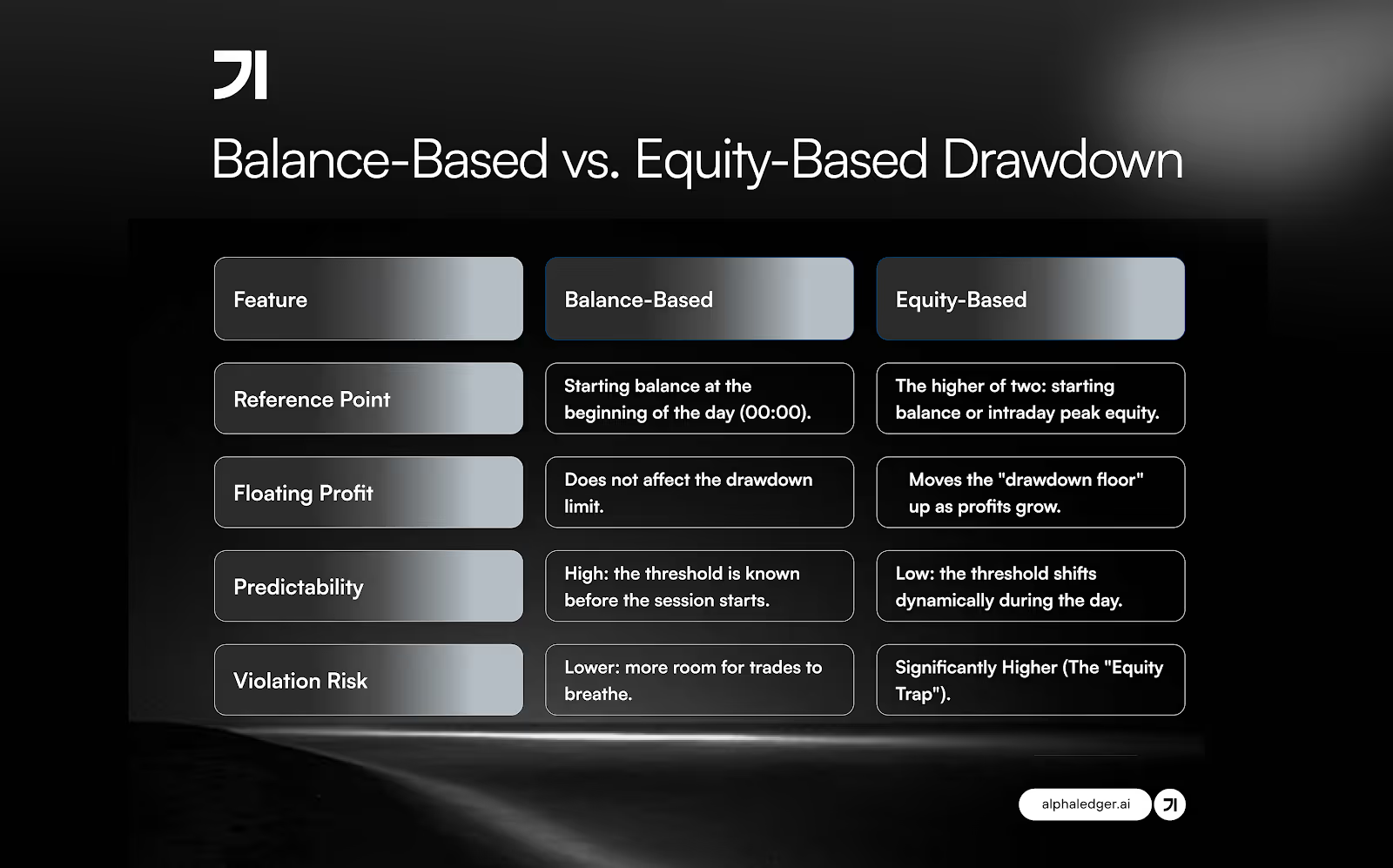
How daily drawdown differs from maximum drawdown
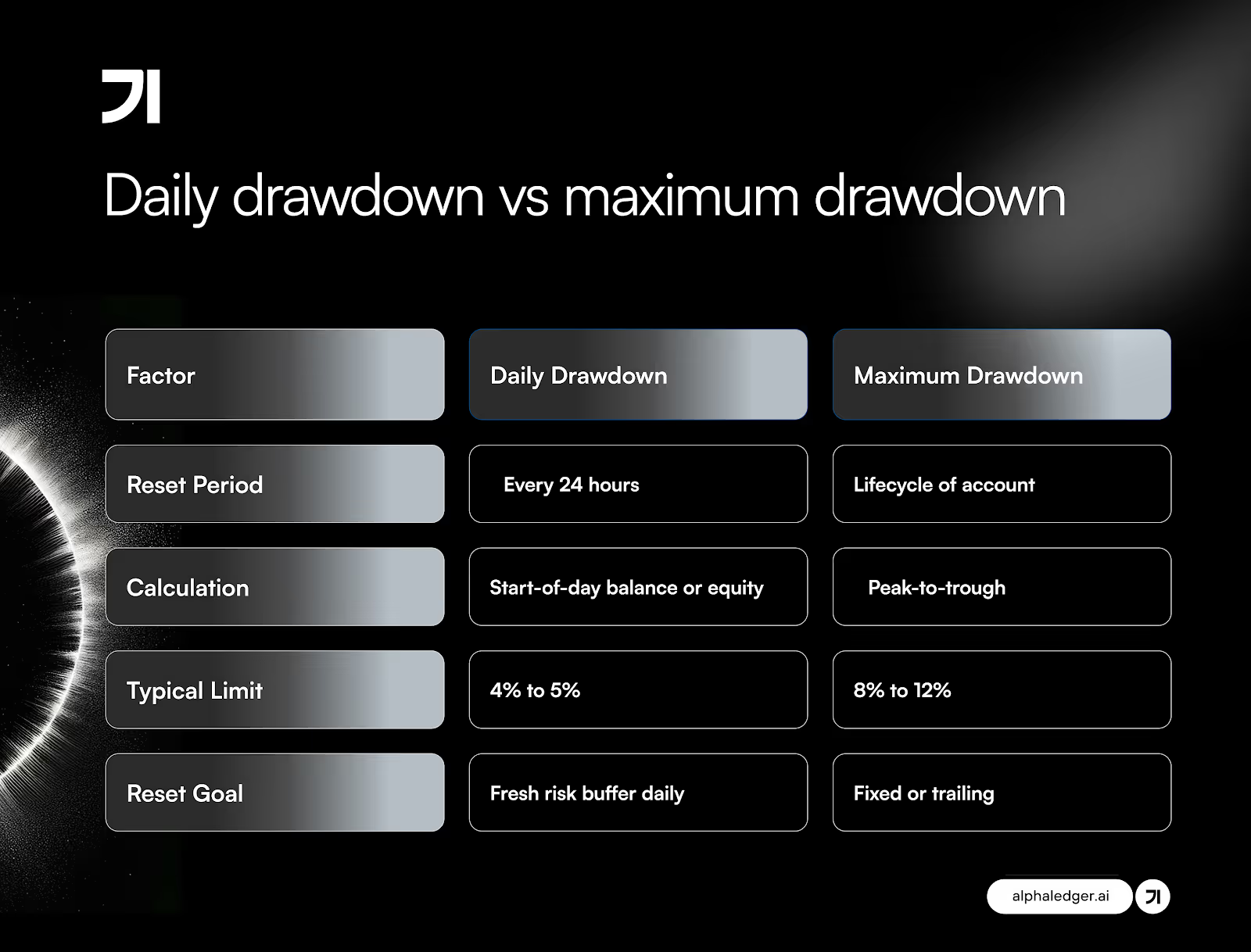
While maximum drawdown is the total "peak-to-trough" loss allowed for the entire account lifecycle, daily drawdown is a recurring daily boundary. You can be well within your overall max drawdown limit and still fail the challenge in a single afternoon if you hit the daily threshold.
Balance-based vs. equity-based rules
Understanding how your firm calculates this limit is the difference between staying in the game and an instant breach:
- Balance-based: The limit is set using your cash balance at the start of the trading day.
- Equity-based (Trailing): The limit follows your floating profit. If you are up $2,000 and the market reverses, that "lost" unrealized profit counts toward your daily drawdown.
Why open trades matter, not just closed trades
A common mistake is assuming the rule only applies to realized losses. In most professional evaluations, the breach happens the moment your equity (floating P&L) touches the limit. If your trades go into a deep draw and then recover to a profit, you have still violated the rule and the account will be disabled.
The traders who pass are not always the smartest. They are usually the ones who stop losing before the rules stop them. Breaking the day’s limit is final - there is no recovery once the hard wall is hit.
Why Traders Fail Daily Drawdown Rules
A drawdown limit violation is rarely the result of a single “bad entry.” It’s a systemic failure. Imagine you’re driving down a narrow mountain road: the cliff is your drawdown limit. You don’t jump over the edge because the road is bad, you fall because you hit the gas when you should be braking.
Oversizing: Overestimating Your Leverage
This is the fastest way to a violation. Traders open positions so large that a tiny 10-point market “noise” instantly eats up their daily risk budget. When your lot size is too large, you have no room to maneuver.
Revenge Trading and the Desire to “Get It All Back”
Have you ever felt that burning desire to immediately recoup your losses? It’s “tilt.” Trying to fix a bad trade in one session usually results in doubling down, ignoring signals, and eventually breaking through the lower limit of your daily limit.
The Correlation Trap
Opening "long" positions on EUR/USD, GBP/USD, and AUD/USD at the same time is not diversification, but tripling your bet against the US dollar. If the dollar strengthens, all three positions will pull your capital to the breakout limit like a runaway locomotive.
Ignoring the Floating P&L
This technical trap has destroyed thousands of accounts. Traders often watch their closed balance, thinking they are safe. But prop firms track capital. If your open trade falls deep into the red, you have broken the rule, even if the price later returns to profit.
High Impact News and Slippage
Holding positions during events like NFP or interest rate decisions is a lottery. Slippage can be so severe that your stop loss will trigger well below the drawdown limit, instantly cutting off your account access.
The question is simple - are you willing to admit that your biggest problem is not the market, but your lack of discipline in managing your own "buffer"?
The Best Way to Think About Daily Drawdown: Protect the Buffer
To survive a challenge, you must shift your mindset: the firm’s drawdown limit is not your usable risk budget. It is a hard concrete wall. If you treat a 5% limit as room to play, you are already inviting a breach. Your professional objective is to stay comfortably away from that boundary at all times.
The power of a personal daily loss cap
Serious traders don't wait for the firm to shut them down; they set a tighter internal threshold. If the official limit is 5%, recommend setting a personal "soft stop" at 3%. Once you hit that 3% mark, you close your terminal. This personal buffer acts as a psychological circuit breaker, preventing the emotional spiral that leads to hitting the hard wall.
By the time the firm’s rules stop you, it’s already too late - be the trader who has the discipline to stop themselves first.
5 Practical Ways to Avoid Violating Daily Drawdown
Professional prop-stock trading requires moving from intuitive gambling to mathematical discipline, but more importantly, it requires knowing when to just walk away.
Here are five strategies that separate funded traders from those stuck in a cycle of frustrating reboots.
1. Set a personal stop loss
Never trade with your back to the firm’s “concrete wall.” If the official limit is 5%, set your personal stop loss at 3%. This “soft stop” accounts for unexpected slippage and, more importantly, preserves your mental capital so you can wake up the next day without feeling defeated.
2. Position sizing will be driven by volatility, not emotion
Let the market dictate your lot size. Use volatility-adjusted position sizing: wider stops during high volatility require smaller lots. Emotional sizing is just gambling; volatility-adjusted sizing is true asset management.
3. Manage correlations as a single risk cluster
Opening EUR/USD, GBP/USD, and gold at the same time is often just one huge, risky bet against the dollar. Treat correlated assets as a single risk cluster to prevent a synchronous hit that could wipe out your daily limit in seconds.
4. Track open limit risk in real time
Firms initiate violations based on floating drawdown, not just closed trades. If your open position briefly exceeds the limit, you will fail instantly, no matter where the price ends up. You must monitor your real capital every second.
5. Stop when behavior deteriorates
The biggest losses occur due to human fatigue and "tilt", not due to bad market settings. If you feel a burning desire to take revenge on a trade or ignore your own rules, close the terminal immediately.
Ultimately, disciplined risk management is the only reliable bridge between a stressful demo account and the freedom of managing real capital.
Daily Drawdown vs. Maximum Drawdown Comparison
In professional prop trading, you aren't just playing against the market, but managing two distinct boundaries simultaneously. Understanding their relationship is the difference between securing funding and receiving a rejection email.
Daily Drawdown: Your 24-Hour Survival Limit
Daily Drawdown is the specific amount you can afford to lose within a single trading session. This limit resets every 24 hours. Even if your total account is up significantly, violating this rule on just one "bad day" leads to immediate disqualification.
Maximum Drawdown: The Structural Integrity of Your Strategy
Maximum Drawdown (Max DD) is the total allowable loss from the highest point of your balance or equity (peak-to-trough) throughout the challenge. It measures your strategic endurance. If daily drawdown is a temporary storm, maximum drawdown is the total depth of the ocean you are navigating.
Why You Must Manage Both Simultaneously
Most retail traders focus on one number, but professionals understand the interplay:
- Tactical vs. Strategic Risk: You can have a profitable week but still fail if one impulsive hour "breaks" the daily limit.
- Institutional Scalability: If your strategy constantly hovers near the max drawdown limit, allocators will view it as fragile and uninvestable.
- Dual-Layer Discipline: Success requires tactical discipline for the current session and strategic patience for the account's lifecycle.
Passing a challenge is like walking a tightrope in a crosswind: you must focus on your immediate balance to stay on the wire today, while never losing sight of the distance remaining to the other side.
What Strong Prop-Firm Risk Management Looks Like
Professional risk management is about having the "street smarts" to protect your capital when the market gets loud. It’s the difference between a trader who panics and one who simply follows a checklist.
The daily habits of funded operators
If you want to move from struggling to funded, your trading day should be governed by these non-negotiable behaviors:
- Pre-defined risk per trade: Never hit the "buy" or "sell" button without knowing exactly how many dollars are at risk. Most pros risk 0.25% to 0.5% per trade during a challenge to keep the "emotional heat" low.
- Session-level stop rules: Have a "strike out" rule. If you lose two or three trades in a row, close the laptop. The market will be there tomorrow, but your account might not be if you stay in "revenge mode."
- The "step-down" approach: If you are down 2% for the day, cut your position size by half. Reducing your exposure after losses is the most effective way to prevent a total daily breach.
- Zero tolerance for doubling down: Adding to a losing position is the fastest way to hit a daily drawdown. Pros accept the "L" and move on. Amateurs try to prove the market wrong.
- News and volatility discipline: If the economic calendar is red, stay on the sidelines or drastically reduce your size. Slippage during high-impact news is a choice, not an accident.
- The "Post-Mortem" review: Every loss is a data point. Successful traders conduct a clear review: Was the loss a part of the strategy, or was it a failure in execution?
True risk management is boring, repetitive, and often involves doing absolutely nothing. It is about building a process so boring that the outcome becomes predictable.
How AlphaLedger Helps Traders Stay Inside the Rules
AlphaLedger acts as a cognitive layer between your strategy and the prop firm’s capital. It helps you move from reactive risk management to measurable performance control, automating the analysis that is often neglected during the heat of a trading session.
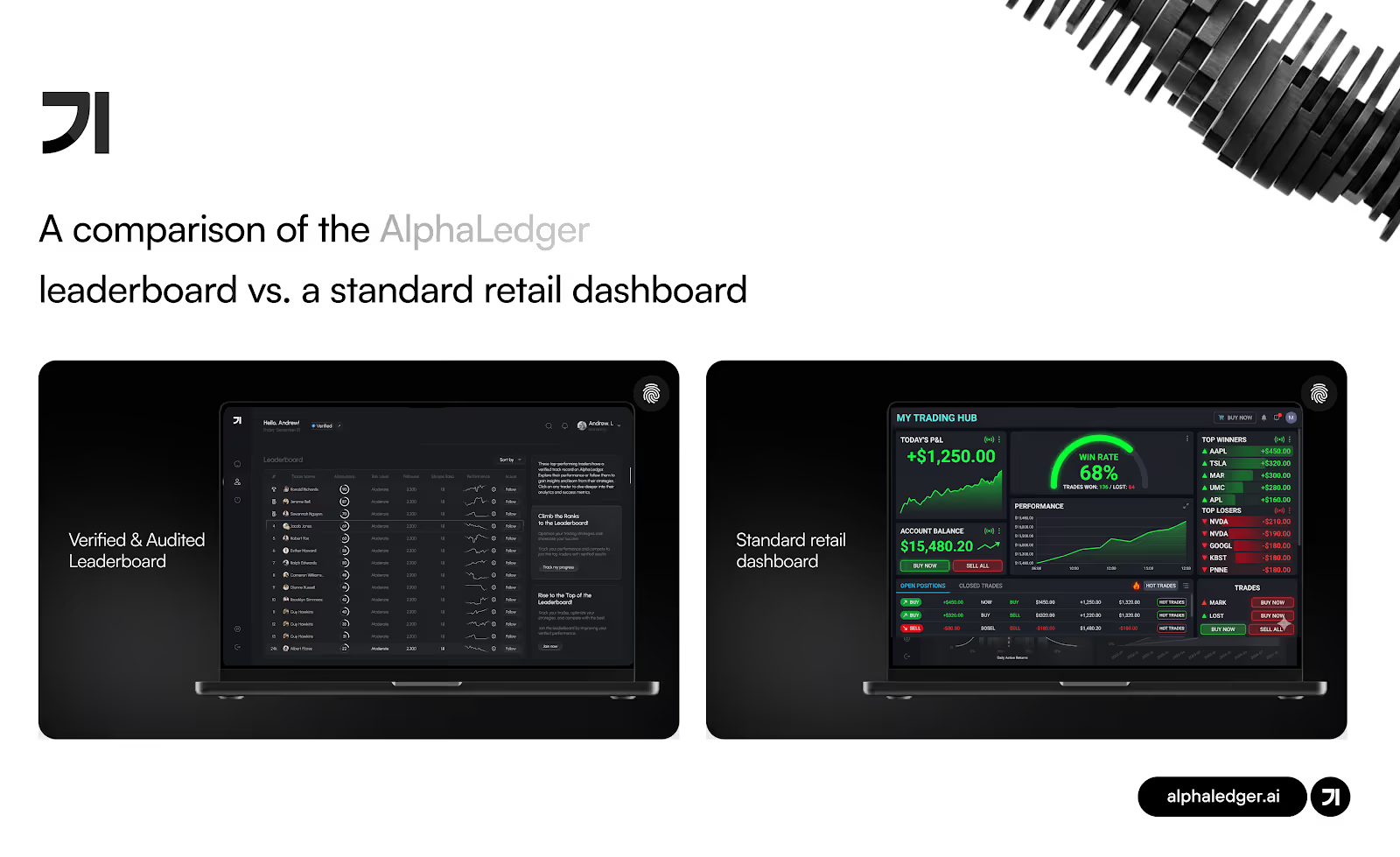
Real-time Performance Monitoring
You see your equity and drawdown dynamics in real-time. This visibility allows you to spot an approaching limit early, before emotional stress compromises your decision-making.
Detecting Behavior Patterns
By highlighting tendencies like oversizing or "revenge trading," the platform allows you to correct your behavior before it results in a lost account.
Drawdown and Execution Trends
Analyzing the depth and duration of previous drawdowns helps you adapt your risk so that temporary pullbacks don't turn into fatal breaches.
Building a Credible Track Record
Beyond protection, AlphaLedger helps you form a verified trading history. Transparent reporting transforms your results from simple screenshots into a high-authority portfolio, ready for demonstration to institutional allocators.
AlphaLedger provides the "why" behind them, turning your trading into a systematic, controlled business.

