


Every trader eventually faces that "cold sweat" moment: the equity curve that was climbing confidently yesterday suddenly flattens or begins a painful slide downward.
At this moment, a dangerous illusion arises. You look at the terminal and see only one conclusion - the strategy is "broken." But the truth is that two entirely different scenarios can hide behind the same result.
Edge vs. Environment
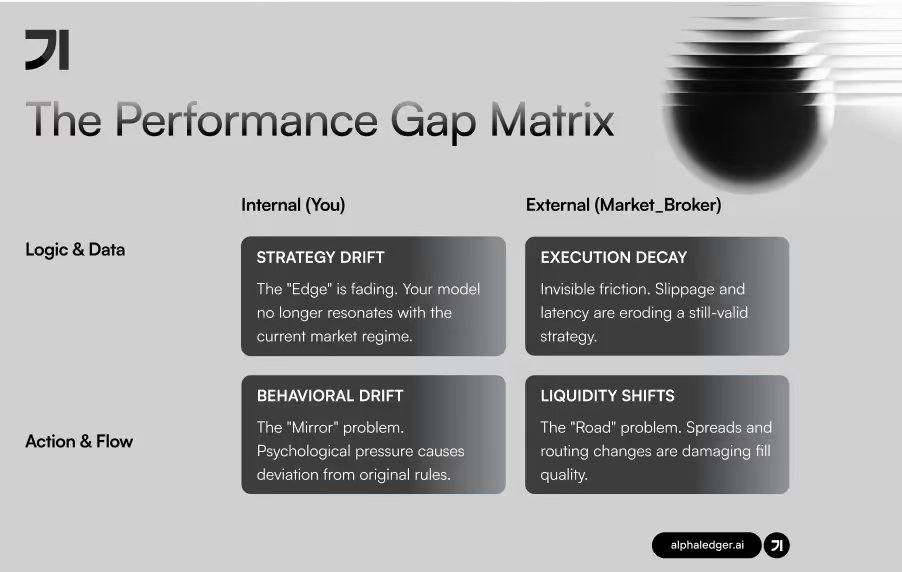
The first scenario is Trading Strategy Drift. Your edge is gradually fading because the market has changed, but your model has not. This is an intellectual problem that requires a rethink of your algorithms.
The second scenario is much more insidious - it is Execution Decay. Your strategy is still brilliant, but the execution environment is quietly becoming your enemy. Slippage, delays, and widening spreads are invisibly eating your profit.
The Cost of a Wrong Diagnosis
If you do not learn to distinguish between these two phenomena, you risk optimizing the wrong thing. You will try to "fix" a profitable strategy when, in reality, you need to change your infrastructure or your broker.
This article is your practical guide to professional diagnostics. We will explore how to understand exactly what is killing your performance in MT4/MT5 and how to turn blurry terminal data into a clear plan of action.
What Strategy Drift Actually Means
Strategy drift is the silent erosion of your trading edge. It rarely announces itself with a crash. Instead, it is a slow, ghostly departure from the performance you once relied on. The setups that used to deliver consistent returns begin to lose their sharpness as the gap between your model and market reality widens.
The Mechanics of Market Evolution
An "edge" is rarely permanent because markets are organic and ever-evolving. Drift often signals that the underlying volatility structure has shifted or the trade setup has become too crowded.
- Regime Shifts: Transitioning from trends to ranges that invalidate your entry logic.
- Crowding: When too many participants exploit the same inefficiency, the alpha eventually disappears.
- Liquidity Shifts: Changes in how orders are absorbed, quietly affecting your expected profit factor.
The Human Element: Behavioral Deviation
Drift is not always mathematical. Sometimes it starts with the "ego-mirror" of the person behind the screen.
- Rule Fatigue: Subconsciously deviating from the plan due to emotional pressure.
- Incremental Risk: Gradually widening stops beyond the original model.
In essence, strategy drift is like a supercar with a worn-out engine: it still looks powerful on the outside, but it can no longer hit the speeds required to win the race. Identifying this internal decay is vital, but to truly master the track, you must also account for the hidden friction of the road itself.
What slippage and execution problems actually mean
Execution issues act as hidden friction that quietly erodes capital. In MT4/MT5, these technical hurdles often mask a still-valid strategy, making it appear as though the edge is failing.
The core mechanics of slippage
Slippage is the price gap between your requested order and the actual market fill, typically peaking during volatile or low-liquidity periods.
Defining professional execution quality
This metric tracks how reliably your broker fills orders relative to real-time market conditions and intended price targets.
The impact of network latency
Even millisecond delays in order transmission can trigger significant price shifts, directly damaging the profitability of high-frequency models.
Liquidity and order routing
Insufficient liquidity often forces orders to fill across multiple price levels, dragging your average entry away from the strategy’s ideal target.
Market volatility and spread widening
Rapid market shifts can widen spreads aggressively, triggering premature stops or forcing entries at unfavorable, non-modeled prices.
The cumulative effect of hidden costs
Execution decay is often a "death by a thousand cuts" where minor slippage clusters aggregate into a major performance drain.
Diagnosing these issues is vital because standard MT4/MT5 history shows what was filled, but it fails to explain the cost of that execution.
Why MT4/MT5 history alone is often not enough
Most traders treat standard terminal history as the ultimate truth. However, from a performance intelligence perspective, these reports are merely surface-level data. They record what happened but completely ignore the conditions under which those facts occurred.
The limits of standard terminal reporting
MT4/MT5 history typically reports only three parameters: what was executed, when it happened, and the final financial result.
The "expected price" blind spot
Standard reports fail to show the gap between the price you saw when clicking the button and the actual fill price, making precise slippage analysis impossible.
Invisible latency clusters
You cannot determine from the terminal whether network latency spiked during critical sessions, directly damaging your entry quality and profit factor.
The illusion of a "broken" strategy
Terminals often lead traders to believe an edge has faded, when in reality, alpha is being eroded by poor broker execution or infrastructure decay.
Settlement and conversion inaccuracies
Standard history often overlooks the nuances of P&L conversion and commission adjustments during rollovers, creating hidden discrepancies in your records.
AlphaLedger fills this information void. Instead of just viewing results, the platform provides a "forensic audit" of every trade, separating your strategy’s skill from the technical noise of the market environment.
How to Tell if the Problem is Drift, Slippage, or Execution Quality
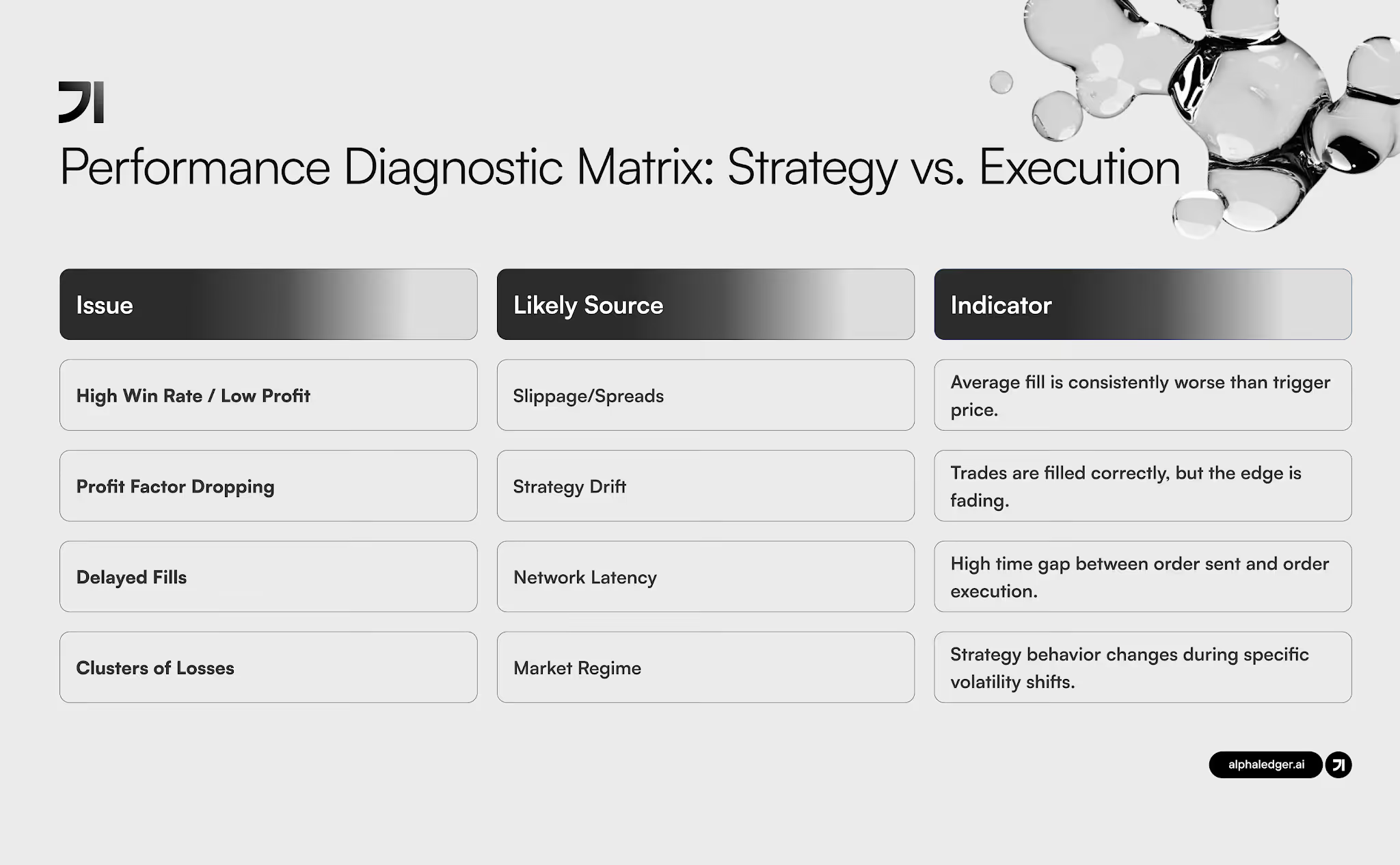
Identifying the source of a drawdown is like performing surgery on your own performance. You need a steady hand and a clear diagnostic map. This framework helps you separate the internal decay of a strategy from the external friction of the market.
Signs of Strategy Drift
This is a "heart" problem - the strategy's core logic no longer resonates with the market's current rhythm.
- The setup underperforms consistently across different brokers and trading sessions.
- Average trade quality declines even when your fills are relatively clean.
- Performance weakens over a large enough sample size to suggest the "edge" is eroding.
- Broad market regime changes, like a shift from high volatility to a flat range - directly break the strategy's structure.
Signs of Slippage or Execution Problems
This is an "environment" problem - your logic is sound, but the road is too slippery to maintain traction.
- The gap between your intended entry price and the actual fill is visibly widening.
- Performance issues cluster strictly around volatility spikes, specific news events, or certain brokers.
- The discrepancy between your backtest (or demo) and live results is unusually large.
- Spread and latency conditions seem to change your outcomes more than the actual setup logic does.
Signs of Behavior Drift
This is a "mirror" problem - the strategy hasn't changed, but your execution of it has under psychological pressure.
- Entries happen later than planned because you are "waiting for extra confirmation".
- Exit points become less consistent as fear or greed replaces your original rules.
- Position sizing changes erratically under pressure, deviating from your risk model.
- The trader feels disconnected from the original process, often leading to impulsive "revenge" trades.
The Diagnostic Mirror
Recognizing yourself in these situations is not a sign of failure, but the first mark of professional growth. By isolating whether the "leak" is in your math, your infrastructure, or your mindset, you stop fighting ghosts and start fixing the real problem.
5 practical ways to diagnose execution problems in MT4/MT5
Identifying the root cause of underperformance requires a systematic audit. Use these five diagnostic steps to determine if your MT4/MT5 strategy is truly failing or if your execution environment has become a silent adversary.
1. Audit intended entry vs actual fill
Monitor the delta between your requested price and the final fill to identify if slippage is eroding your expected alpha.
2. Analyze slippage by session and volatility
Identify "toxic" environments by tracking execution quality across specific time slots, currency pairs, or market conditions.
3. Benchmark live performance against backtests
Isolate the "friction gap" by comparing live results to pristine backtest data to see where reality deviates from your model.
4. Track latency and timing consistency
Monitor execution speed to detect millisecond delays that damage P&L long before they become visible in the terminal logs.
5. Isolate execution from strategy decay
Confirm that poor fills or broker routing are not the culprits before making unnecessary changes to a potentially profitable algorithm.
By following this diagnostic path, you stop guessing and start measuring. Only when you strip away the technical noise can you see the true health of your strategy and make decisions based on forensic facts rather than terminal anxiety.
What serious traders should monitor over time
Professional success in MT4/MT5 depends on controlling the operational data behind the final result.
Slippage trend
Monitor slippage dynamics to detect deteriorating broker liquidity or the negative impact of your order size in real time.
Fill quality consistency
Analyze order execution reliability to ensure that technical glitches or broker routing changes are not eroding your strategy.
Maximum Adverse Excursion (MAE)
Measure price behavior immediately following an entry to identify timing issues or exposure to toxic order flow.
Performance by market regime
Classify results by market state (trend vs. range) to know exactly under which conditions your edge remains most robust.
Drawdown by session and broker
Distribute drawdowns by trading time to isolate strategic errors from session-specific liquidity gaps.
Deviation from execution plan
Track the gap between your theoretical model and live actions to detect behavioral drift or infrastructure decay early.
This checklist transforms trading from a game of chance into a managed process where every parameter is subject to audit and optimization.

STRATEGIC FAQ
FAQ 1: What is strategy drift in trading?
A: Strategy drift happens when a system that once performed well starts losing effectiveness over time, often because market conditions change or the strategy no longer behaves as originally expected.
FAQ 2: What is slippage in MT4/MT5?
A: Slippage is the difference between the price a trader expects and the actual price the order is filled at. It can happen because of volatility, liquidity conditions, spreads, or execution delays.
FAQ 3: How can AlphaLedger help detect strategy drift?
A: AlphaLedger publicly positions itself around strategy behavior tracking over time, execution-level analysis, and spotting degradation or drift early, which can help traders understand whether results are weakening because of the strategy or the execution environment.
FAQ 4: Can AlphaLedger help analyze slippage and execution quality?
A: Yes. AlphaLedger explicitly references execution-level analysis that surfaces slippage and latency, allowing traders to trade with confidence by having deeper visibility into live performance behavior.
FAQ 5: Does poor execution always mean a strategy is bad?
A: No. A strategy can still have edge while live results suffer because of slippage, latency, spread conditions, or poor timing. That is why traders need to separate execution problems from actual strategy drift.
How AlphaLedger Helps Traders Spot Drift and Execution Issues Earlier
Trading in 2026 is a war against invisible friction. If your strategy is a sailboat, poor execution is the underwater current dragging you off course while you desperately patch the sails.
AlphaLedger makes the water transparent, transforming raw data into an intelligent asset that bridges the gap between skill and investor trust.
Removing Terminal Blind Spots
Standard MT4/MT5 logs only record the final result, hiding the "invisible bleed" of execution decay. AlphaLedger performs high-resolution execution analysis to reveal what lies behind the P&L.
- Slippage & Latency Visibility: Pinpoint every millisecond of delay and every pip of slippage.
- Verified Observability: Use direct API connectivity to turn private activity into an indisputable, tamper-evident asset protected by high-standard monitoring controls.
Identifying Algorithmic Fatigue
Strategies rarely die instantly. They degrade quietly. AlphaLedger tracks strategy behavior over time, allowing you to catch "drift" before it hits your maximum drawdown.
Instead of guessing during a losing streak, you can clearly distinguish:
- Internal Decay: Has the logic stopped resonating with the current market regime?
- External Friction: Are results failing due to deteriorating broker liquidity or routing?
Moving to Institutional Trust
Professional maturity begins when intuition is replaced by evidence. AlphaLedger provides the "black box" recorder required to prove you control your environment and are ready to scale.
Stop fighting ghosts in your terminal. Connect your account to AlphaLedger and turn your trade history into a verified, high-fidelity financial asset.

